




 Menu
MenuHow Office Furniture Shapes Movement and Attention: The Hidden Psychology of Workplace Wayfinding
How Office Furniture Shapes Movement and Attention: The Hidden Psychology of Workplace Wayfinding
Most people think of wayfinding in offices as being driven by signage, floorplans, or architecture. In reality, a significant influence on how people move, pause, and visually orient themselves in a space is shaped by something even more subtle: office furniture geometry and directional cues embedded in its design language.
Research in environmental psychology and spatial cognition consistently shows that people do not navigate interiors purely through logic. Instead, they rely on a combination of visual attention, perceived affordances, and subconscious environmental cues that help them understand where to go, where to stop, and what matters in a space. Studies in eye-tracking and visual cognition show that design elements directly shape how we perceive a space and where attention is drawn at first glance. (1)
Furniture as a Subtle Wayfinding Influence
Applying this research to the modern office environment, it becomes apparent that elements as simple as seating, desk shape, and coffee or meeting tables play a large role in how organisational structure is perceived. Using these cues can influence movement patterns and define natural interaction or collaboration points. In other words, your furniture doesn’t just occupy a space, it quietly directs it.
Wayfinding often relies on signage and circulation routes. However, environmental psychology highlights a broader concept: people use landmarks, visual hierarchy, and structural cues to orient themselves. Shape, lighting, and material all play a part in creating this system, acting as navigational anchors within a space. Furniture plays the same role, supporting this visual system in a more subconscious way. (2)
Forms, edges, curves, and bases all contribute to how the eye moves through a room. Sharp angles tend to act as directional cues, whereas soft curves create a greater sense of flow and collaboration. Vertical emphasis draws attention upwards. For instance, a high-back chair can create a perception of authority, while multiple low-back chairs together encourage openness and conversation. A wide table base positions it as a place for longer, more formal congregation. A comparatively thin base strikes a more informal tone, appearing better suited to quick conversations or more intimate moments. These are not coincidences; they are perceptual triggers that guide movement and shift attention throughout a room. Although comfort and aesthetics play a large role in furniture selection, it’s important to consider their silent spatial language too. (2)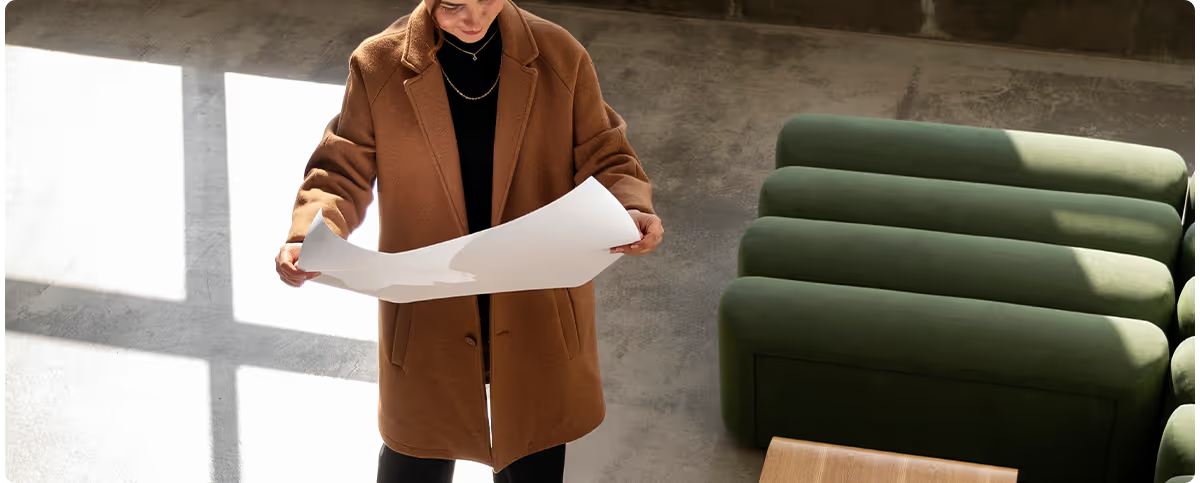
How these design elements are used in practice
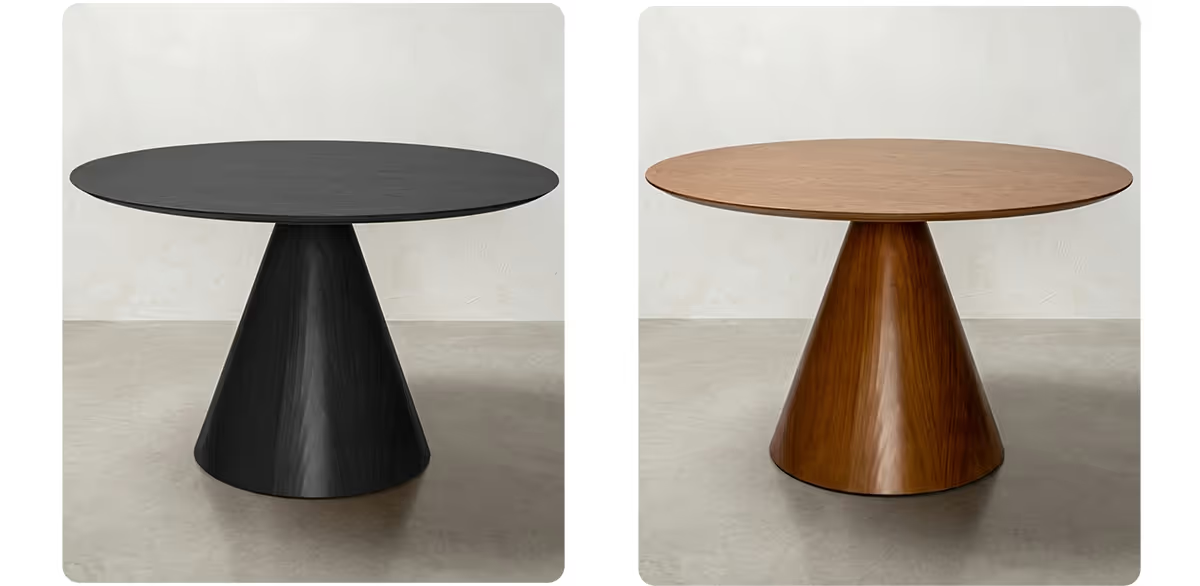
An example of how this subconscious wayfinding approach can be applied is the Egmont table
Egmont uses its conical base to create a visual taper that draws the eye upward, naturally converging attention toward the tabletop. Psychologically, it creates the perception of a centralised ‘event point’ in the room. The form behaves almost like a quiet visual arrow, guiding attention from the wide, grounded base to a shared focal point above. Without realising it, when you enter the room it becomes the first place you’d consider meeting (provided you have adequate seating).
In open-plan areas, it becomes a clear meeting point, subtly indicating ‘this is where interaction happens’. Combined with other spatial cues, this design language can drastically alter how people interact with a space and where they’re naturally guided. This can be applied to both offices where people use the same space every day, and to public shared environments like waiting rooms or libraries, where it’s necessary to guide intuitive movement through unfamiliar territory.
Guiding Foot Traffic
Horizontal furniture elements can subtly guide movement through a workplace, helping establish circulation paths and drawing attention toward shared interaction zones.
Take Tri seating for example. Its angular composition creates inherent visual vectors; the sharp angles in the design form a more obvious “arrow” for both the eye and foot to follow. Rather than blending into the space, Tri introduces intentional breaks in form to create implied movement lines. Not only does this help define zones, it can also reduce reliance on physical signage and unnecessary visual clutter.
This style is particular useful in spaces where a clear path is necessary, such as hospital corridors or busy environments where key destinations need to be easily identified. 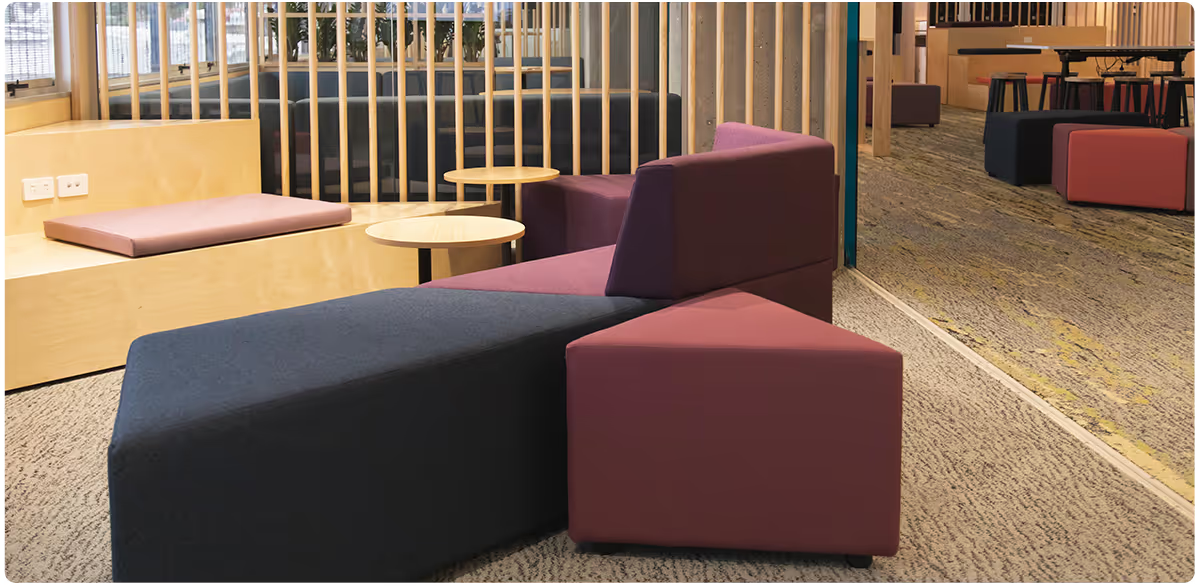
[Pictured: Tri Seating installed for TSB]
Media Seating
Curved seating options like custom-built Media or XOXO operate in a similar way to Tri, but with a few key differences.
Rather than sharply directing attention, curved options give a space more flow and a greater sense of choice in how it’s navigated. Movement becomes less structured and more experience-driven. Curves reduce visual interruption, allowing a space to feel more unified. Instead of edges signalling separation, they create continuity, encouraging smoother, more organic movement.
This works particularly well in spaces where the emphasis is on comfort and collaboration rather than direction, such as waiting areas, foyers, or reception spaces. Where Tri creates strong directional paths, curved seating supports smoother transitions between zones and more relaxed, natural movement.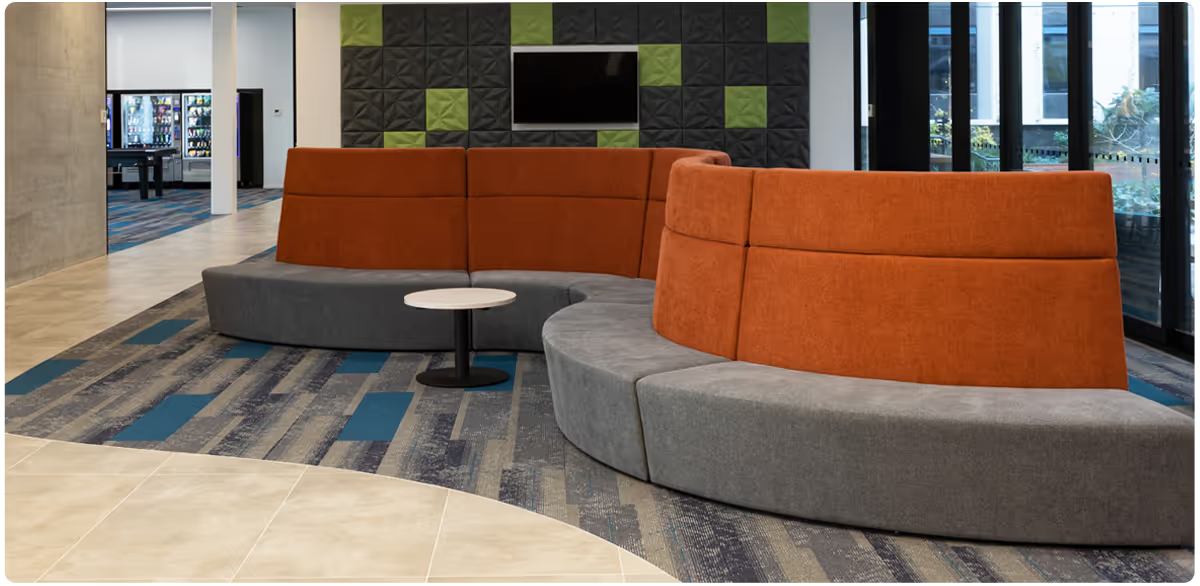
[Pictured: Media Seating built and installed for Carlaw Park]
Examples in Context
Tri modular seating works like a museum exhibition. Its angular geometry introduces direction and sequence, subtly encouraging people to move through a space in a particular way. Much like a curated timeline where each moment builds on the last, the sharp lines and defined edges create a sense of progression. People instinctively follow these cues, moving from one point to the next with purpose. In environments where order matters, such as structured collaboration zones, circulation paths, or high-traffic areas, this kind of directional furniture can significantly improve flow and reduce hesitation.
Curved Media seating, on the other hand, behaves more like an open art gallery. There’s no prescribed route, no single “correct” way to move. The soft, continuous lines allow the eye and body to wander naturally, creating a more relaxed and exploratory experience. People can approach, pause, and interact with the space in whatever order feels intuitive. This makes it particularly effective in breakout areas, waiting zones, or informal meeting spaces where flexibility and comfort take priority over structure.
Both approaches are equally valuable, but they serve very different purposes. Directional forms help organise movement and create clarity, while curved forms support freedom and fluidity. Used intentionally, they can dramatically shape how people experience and navigate a space.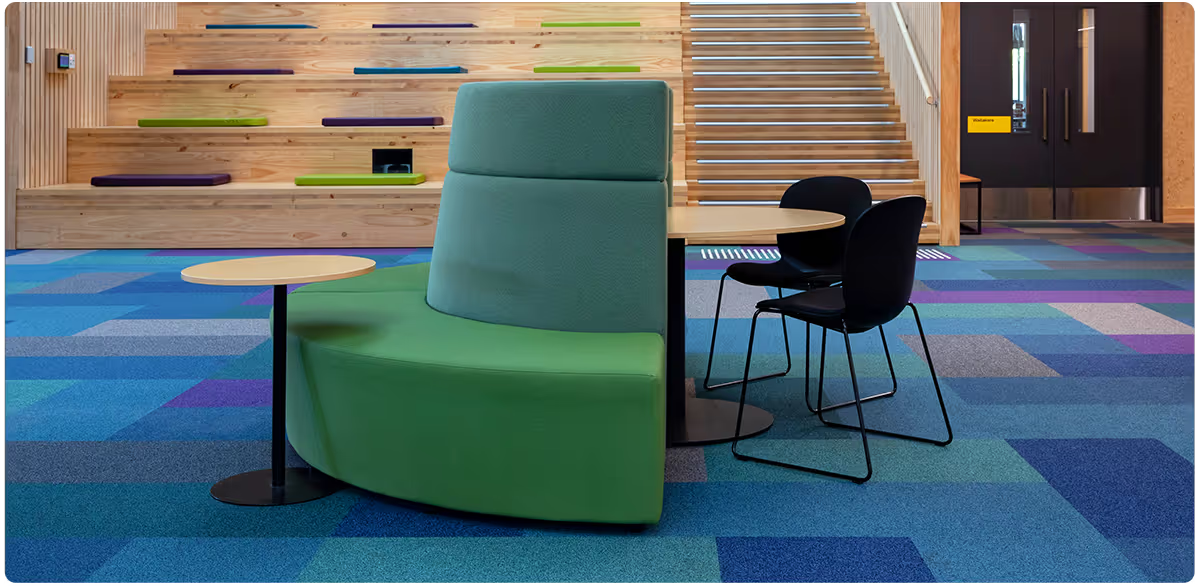
[Custom Media Seating installed at western Springs College]
What this Means in Practice
The visual language of furniture plays a large role in shaping how a space is experienced. There is no one-size-fits-all approach to wayfinding through furniture; it depends entirely on the purpose of the space.
Environmental psychology research shows that visual attention is constantly allocating cognitive resources to different elements in a space, and that design features such as form, material, and layout influence how attention is distributed. (3)
When applied intentionally, furniture becomes part of a larger cognitive system:
- Angular forms create directional cues
- Vertical structures create focal anchors
- Curved forms create flow and continuity
As workplaces shift toward hybrid, activity-based environments, clarity of spatial navigation becomes more important than ever. Employees are no longer anchored to fixed desks, meaning environments must communicate function and flow more intuitively.
Well-designed furniture reduces cognitive load. It helps people understand:
- Where to go
- Where to gather
- Where to focus
- How to transition between tasks
The most effective workplaces go beyond visual consistency or functional efficiency. They need to feel immediately understandable the moment someone steps into them. True spatial clarity comes from guiding intuition through considered design, rather than relying on signage or overt direction.
This approach has shaped many of our fit-outs, where a balance of directional forms and open flowing elements is used to naturally support how a space is meant to be interacted with. The result is an environment that not only looks cohesive, but quietly communicates how to move, gather, and work within it.
If you’re exploring how thoughtful design can elevate your workspace, get in touch with the team or browse the BFG range to see how these principles come to life.
Sources:
1. Orlu Özen, G., Imamoğlu, Ç., Surer, E., & Altay, B. (2026). Visual attention allocation between social and navigational cues during wayfinding: An eye-tracking study in virtual reality. i-Perception, 17(1), 1–27.
https://pmc.ncbi.nlm.nih.gov/articles/PMC12929869/
2. Saman Jamshidi, Mahnaz Ensafi, Debajyoti Pato (2020). Wayfinding in Interior Environments: An Integrative Review
https://www.frontiersin.org/journals/psychology/articles/10.3389/fpsyg.2020.549628/full
3. Ann Sloan Devlin (2021) Environmental Perception: Wayfinding and Spatial Cognition
https://doi.org/10.1093/oxfordhb/9780199733026.013.0003
How Office Noise Hurts Productivity and What to Do About It
Modern workplaces are designed to encourage collaboration, flexibility, and open communication. Open-plan layouts have become common across offices in New Zealand and globally because they allow teams to interact more easily and make efficient use of space. However, open environments often introduce a new challenge: noise. Conversations, phone calls, keyboard sounds, and background movement can quickly build into a constant level of noise that makes concentration difficult. While these sounds may seem minor individually, research shows they can significantly affect focus, productivity, and employee wellbeing. Understanding how workplace noise impacts performance is the first step toward creating office environments that support both collaboration and focused work.
READ MORE